Surviving Trolleys & Buildings
It has now been over 70 years since the last electric trolley operated in central Maryland, yet many remnants survive.
In many areas, portions of the route can still be found in landscaping, flat, straight paths alongside power lines which very slowly erode away or are lost to the construction of developments. Some well preserved portions of the lines to Boonsboro and over South Mountain can still be found nearly 90 years since the tracks were removed!
Surviving Trolleys
Four trolleys still survive
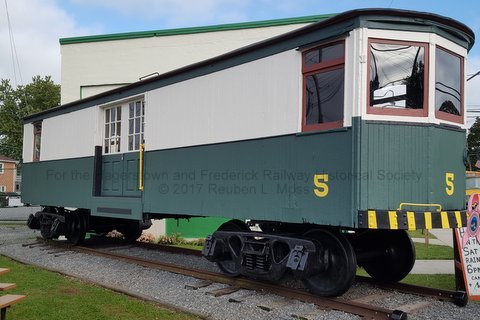 #5 (Freight/Express Motor )
Location: Main Street, Thurmont, MD
Built: 1920, H&F Railway, Frederick Carbarn
This trolley was built in Frederick from lumber and parts of older trolleys. It served all lines of the railway, and remained in service until 1955. This type of car could carry freight inside as well as pull several regular railroad freight cars at a time.
It spent time as a garden shed, and then went to the Rockhill Trolley Museum before being moved to Thurmont around 2005.
Today it is the centerpiece of a park on the site of Thurmont’s trolley station.
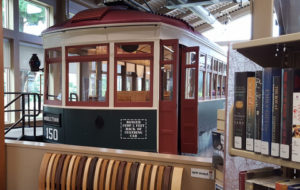 #150 (Suburban Coach)
Location: Myersville Community Library
Built: 1918, Perley Thomas Car Works, High Point, NC
Built to transport troops between Camp Jackson and the city of Columbia, SC during the first World War, this passenger-only trolley could transport up to 44 seated passengers at a time. After the army temporarily closed the camp, this car and several like it went into storage before being sold to the Hagerstown & Frederick Railway in 1923 to fill a need for more passenger service between Hagerstown and Boonsboro.
Cars 150 – 153 served Boonsboro until the end of service in late 1938, and then went to Frederick where they were retired in 1939.
This car was incorporated into a cabin near Gambrill until being purchased in 1993 and restored by Don Easterday of Myersville. It was the centerpiece of the Myersville Trolley Festival from 1994 – 2012. After Mr. Easterday passed away in 2016, the Town of Myersville purchased and renovated the car for safe permanent display.
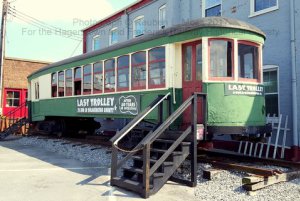 #168 (Interurban Combine)
Location: Hagerstown Roundhouse Museum
Built: 1917, J.G. Brill Company, Philadelphia, PA
The first steel-side car bought by the Hagerstown & Frederick Railway, this car replaced a previous #168 which was a similar all-wood car destroyed in the Hagerstown Carbarn fire that year. It was the first in a series of similar cars which became the signature equipment of the railway.
This trolley served Hagerstown to Frederick mainline service from 1917 to 1938, and could carry up to 48 passengers as well as baggage and cargo. When the mainline closed, it was kept in Hagerstown for service to Williamsport until that line closed in 1947.
168 was completely gutted of its interior and became a cabin near Dam 5 along the C&O Canal. When the National Park Service began clearing residences from along park property, the car was donated to the Hagerstown Model Railroad Museum, then located at the Hagerstown Fairgrounds. When that organization relocated to Antietam Station, they donated to the car to the Hagerstown Roundhouse Museum where it remains today.
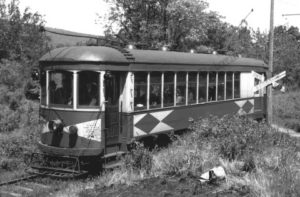 #171 (Interurban Combine)
Location: Private Property in Frederick County
Built: 1919, J.G. Brill Company, Philadelphia, PA
Similar in design to #168, car 171 also served the Main Line until that route closed in 1938. Combine 171 was then assigned to Thurmont for the rest of its service life, becoming one of the last two interurban trolleys to carry passengers on a regular schedule east of the Mississippi River.
171 was a popular subject of photographers over the years.
After retirement, the car was relocated to a wooded area and became a private cabin, which it remains today. Of the four trolleys, #171 is kept in the best and most complete condition.
While some have argued that this car is actually #172, there is photographic proof as well as witness accounts documenting the destruction of #172. In addition, several cosmetic details differed between the cars which helps to prove that the surviving car is in fact #171. Parts of #172 survive on display in our Trolley Station Museum.
Surviving Buildings
Several buildings related to the railway survive as well…
Trolley Carbarns
Hagerstown Carbarn – Intersection of Summit & Lee Streets in Hagerstown
Frederick Carbarn – East Patrick Street at Carroll Creek in Frederick
Company-Built Station Buildings
Boonsboro Trolley Station – Now housing our museum
Frederick Terminal Station – Intersection of Carroll & E. Patrick Streets in Frederick
Myersville Station – Rightmost section of a building with columns on Main Street
Braddock Heights Station – Beside Braddock Heights Post Office, Maryland & Schley Avenues, Braddock Heights
Mt. Tabor Road Station (Station Road Shelter) – Now displayed outside of Myersville Town Hall
Private buildings used as trolley stops
Ford’s Store – Now a home, intersection of Beaver Creek and Mapleville Roads
Lewistown Co-Op Building – Now private storage, Hessong Bridge and Powell Roads, Lewistown
Yellow Springs – Yellow Springs Road near elementary school
Shady Grove, PA – Town Post Office, once was Winder’s Store. Trolley ticket office was on the other side of the parking lot.
I addition, a house along Hebb Road is suspected as having served passengers by contract.
Power Plants
Williamsport “Trolley Barn” – Cushwa Basin, Washington County’s first power plant.
R. Paul Smith Plant – The large power complex at Williamsport, closed 2012
Security Plant – Now Allegany Door & Window, Security, MD
Many other older power buildings in the region.
Trolley Substations
Power substations at Braddock Heights Station, Yellow Springs, Thurmont, and some other locations are built from the original trolley substations on the same or similar spots.
Surviving block structures at Thurmont, Yellow Springs, and a brick structure at East & Fifth Streets in Frederick all once contained substation equipment related to the trolley system.
Bridges
Remains of several bridges can still be found. Most are now on private property.
- Hunting Creek, restored as part of Thurmont Trolley Trail (Concrete supports, new deck)
- Catoctin Furnace near Red Bird Lane (Concrete supports)
- Sandy Run alongside Hessong Bridge Road (Concrete supports)
- Fishing Creek Dual Bridge, across from Powell Road at Hessong Bridge Road, Lewistown (Pier and concrete supports)
- Private Property near Braddock Heights, East slope.
- Above road in trees, Braddock Heights, West slope. (Stone supports)
- Near Willowtree Drive, Middletown (Concrete supports)
- Near Cone Branch Drive, Middletown (Footers for steel supports)
- Private Property between Middletown and Myersville (several locations with small concrete supports)
- Rudy’s Hollow over Little Catoctin Creek, private property (Multiple concrete piers and supports, one fallen)
- Catoctin Creek, alongside Rt. 17 (Multiple concrete piers and supports)
- Easterday property (Stone supports)
- Near South Mountain Summit (Stone supports at low spot, visible from Rt. 40)
- East side of I-70W just below summit (Concrete supports)
- Culvert in surviving trackbed at Mt. Lena (Stone and pipe)
- Beaver Creek Road near Beaver Creek Storage (Concrete support)
Others and locations of others can be found across the routes in farmland.
Many other remnants survive, including concrete steps and smaller culverts, cuts, and built up areas.