Construction and Engineering
In 1976, the Army Corps of Engineers declared the Historic National Road to be a National Civil Engineering Landmark. The road pushed our young nation’s capacity for building and overcoming challenges to the edge of its abilities, and formed a framework for the growth of the country through the transport of people and goods over the Appalachian Mountains.
The National Road also became a proving ground for construction methods.
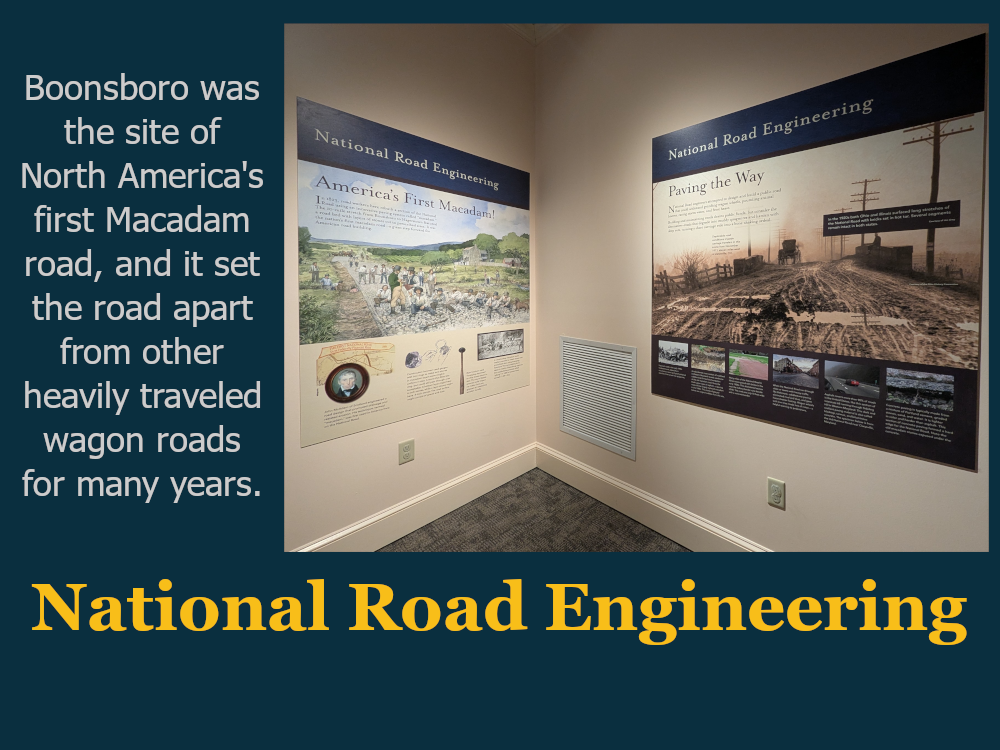
In 1823, the Boonsborough Turnpike Road from here to Hagerstown became the first roadway in North America paved using macadamization, a process developed by John Loudon McAdam of Scotland. Soon after, federal construction crews began using the process on the newly constructed road being built beyond the mountains.
Portions of the roadway were also build using crushed gravel, brick, cobblestone, and in later years upgraded to concrete and asphalt. All of these methods combated the dangers weather introduced to plain dirt roadways.
These two panels examine that history.
Phase II
This exhibit will drastically change with Phase II funding.
A new standalone kiosk exhibit will be constructed in the center of the exhibit hall, on wheels so that it may be moved for special events. In addition to these, two additional panels of information and several artifacts will be included. Examples of each road surface will be placed as tactile surfaces for visitors to see, touch, and feel.

An early rendering fo the Communications Exhibit.
In this corner, a new exhibit touching on the construction of telegraph and telephone wires along roadways and the importance of communication will replace Engineering.